

Recent Research on Neural Network Connectivity in Late-Life Depression and Anxiety
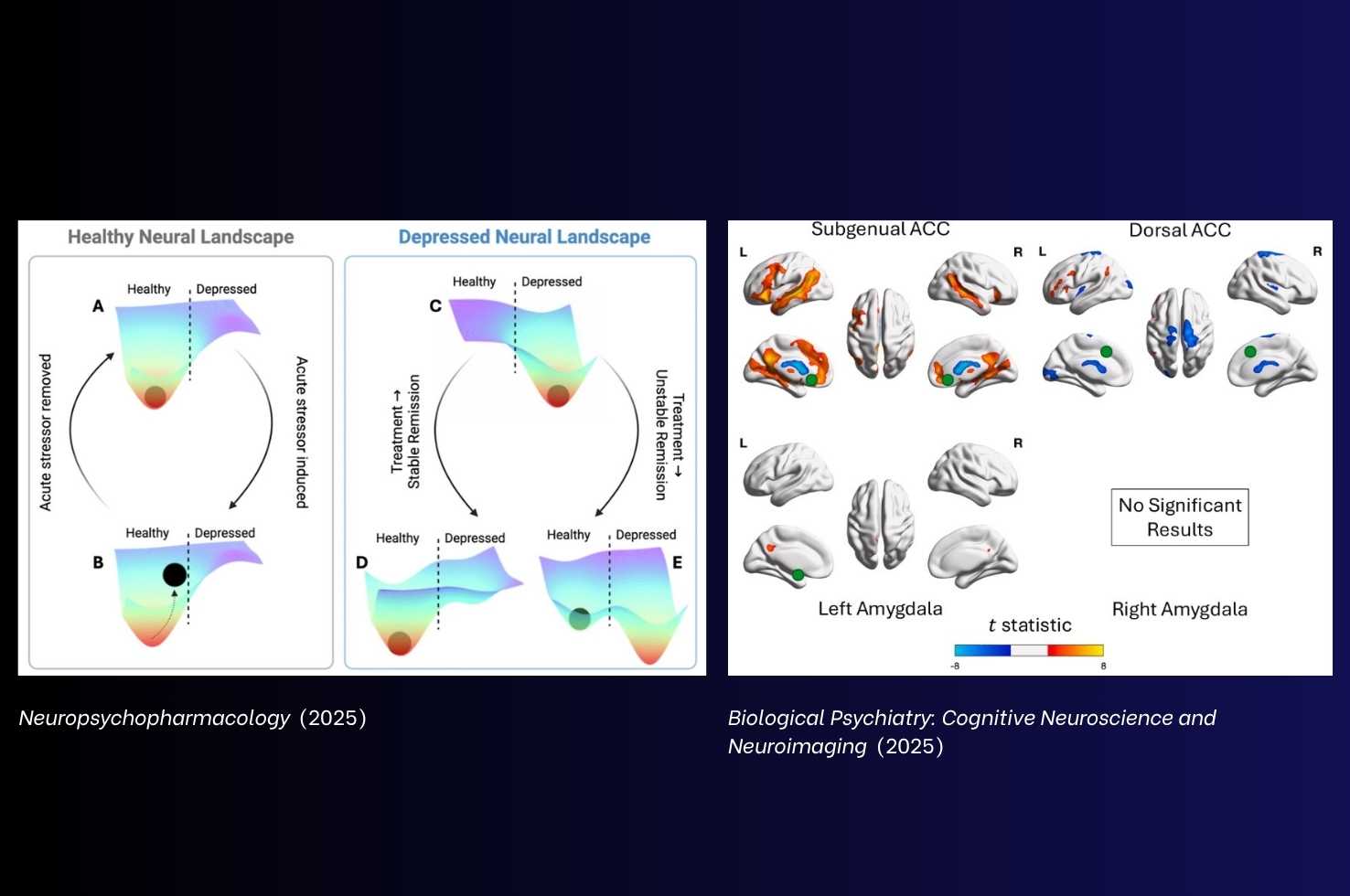
Recent papers in Neuropsychopharmacology and Biological Psychiatry: Cognitive Neuroscience and Neuroimaging examine neural connectivity in late-life anxiety and depression. “Together, these two studies highlight the central role of the default mode network—a diverse set of brain regions theorized to integrate our experiences and sense of self—and its relationship with other large-scale brain networks in affective disorders,” said Andrew Gerlach, PhD (Assistant Professor of Psychiatry and Bioengineering), first author of both studies.
Network Homeostasis: Functional Brain Network Alterations and Relapse in Remitted Late-Life Depression
Depression can be prevalent in late life, and even following successful treatment, older adults are highly vulnerable to recurrence. In a recently published paper in Neuropsychopharmacology, investigators including Dr. Gerlach, Helmet Karim, PhD (Assistant Professor of Psychiatry and Bioengineering), and Carmen Andreescu, MD (Professor of Psychiatry and Bioengineering), studied relapse and recurrence of late-life depression in 111 adults age 60 or older (47 with stably remitted depression, 25 experiencing depression relapse, and 39 unaffected comparison subjects).
The investigators found that participants with remitted late-life depression had lower connectivity within the somatomotor network and greater connectivity between the executive control and default mode networks, compared with healthy comparisons. Stable remission and relapse differed primarily by lower connectivity between the default mode network and salience and somatomotor networks in the relapse group, which also predicted time to relapse. Overall, the connectivity of participants that went on to relapse was more similar to healthy comparisons than was the connectivity of the stable remitted participants—indicating substantial reconfiguration of functional network architecture may be required to maintain remission.
Gerlach AR, Karim HT, Kolobaric A, Boyd BD, Kahru K, Krafty RT, Ajilore O, Taylor WD, Andreescu C.
Neuropsychopharmacology. (2025). https://doi.org/10.1038/s41386-025-02138-8
The Desegregation of Neural Networks During Worry Induction in Late Life: An Effective Connectivity Analysis
Worry is a core component of several anxiety disorders, a common symptom of depression, and a frequent feature of other psychiatric illnesses. In addition, older adults’ ability to cope with worry may be impaired by age-related structural and functional decline of neural circuits.
Scientists including Dr. Gerlach, Dr. Karim, Dana Tudorascu, PhD (Associate Professor of Psychiatry and Biostatistics), Meryl Butters, PhD (Professor of Psychiatry and Clinical and Translational Science), and Dr. Andreescu investigated functional coherence (termed effective connectivity) using functional magnetic resonance imaging of a naturalistic worry induction and reappraisal task in 112 participants older than age 50.
Findings from the study, recently published in Biological Psychiatry: Cognitive Neuroscience and Neuroimaging, revealed that during the worry induction task, effective connectivity increased between the subgenual anterior cingulate cortex and the default mode network and major hubs of the executive control and salience networks. Reappraisal reduced subgenual and dorsal anterior cingulate cortex effective connectivity observed during worry and the effective connectivity between the left amygdala and regions of the dorsal attention network. Together, these findings show that worry subsumes cortical resources across higher order associative networks, while reappraisal reestablished network segregation. Left amygdala effective connectivity to the posterior cingulate also increased during worry, and dorsal anterior cingulate cortex connectivity to primary sensory and motor regions decreased. Left amygdala effective connectivity, in particular, was associated with in-scanner worry severity.
Gerlach AR, Karim HT, Kahru K, Tudorascu DT, Gross JJ, Butters MA, Andreescu C.
Biological Psychiatry: Cognitive Neuroscience and Neuroimaging, 2025, ISSN 2451-9022, https://doi.org/10.1016/j.bpsc.2025.04.010.
“These studies point toward intricate dynamics involving the canonical brain networks in late-life mood and anxiety disorders, hopefully contributing to the current movement in the field from static, local activation/deactivation paradigms toward complex interactions among brain networks,” said Dr. Andreescu, senior author of both studies.