
University of Pittsburgh logo
Department of Psychiatry
University of Pittsburgh logo
Information for You
  • Faculty & Staff
  • Prospective Trainees
  • Investigators
  • Patients & Families
Our People
Menu
  • Education
    • Education Overview
    • Residency & Fellowships
    • Research Training
    • Medical Student Education
    • Clinical Psychology Internship
    • Clinician Career Development
  • Research
    • Research Overview
    • Research Faculty
    • Research Training
    • Investigator Resources
    • Health Equity Research
    • Participate in Research
  • Clinical
    • Clinical Overview
    • Clinical Faculty
    • Schedule an Appointment
    • Clinical Services
    • Resources for Clinicians
  • Community & Culture
    • Community & Culture Overview
    • Leadership & Advisory Council
    • Research Equity & Community Health (REACH)
    • Community & Partnership
    • Community News
  • About Us
    • About Us Overview
    • Chair's Message
    • Our People
    • Our History, Our Present, & Our Future
    • Life in Pittsburgh
  • News & Events
    • News & Events Overview
    • News
    • Events
  • Information for You
    • Faculty & Staff
    • Prospective Trainees
    • Investigators
    • Patients & Families
  • Our People

Main menu

  • Education
    • Residency & Fellowships
      • Residency Training
      • Training Pathways & Concentrations
      • Clinical Fellowships
      • Our Clinical Learning Environment
      • Our Leadership
      • Our Chief Residents
      • Our Residents
    • Research Training
      • Undergraduate & Graduate Student Training
      • Medical Student Research
      • Research During Residency
      • Postdoctoral Training
      • Medical Student Education
      • Clinical Psychology Internship
      • Clinician Career Development
  • Research
    • Research Training
      • Undergraduate & Graduate
      • Medical Student Research
      • Research During Residency
      • Postdoctoral Training
    • Investigator Resources
      • Research Day
      • Research Review Committee
      • Assessment Instruments
    • Health Equity Research
      • REACH Collaborative
      • Research Faculty
      • Participate in Research
  • Clinical
    • Resources for Clinicians
      • Psychiatry Advances Podcast
      • UPMC Physician Resources
      • Clinical Faculty
      • Schedule an Appointment
      • Clinical Services
  • Community & Culture
  • About Us
    • Our People
      • Faculty
      • Staff
      • Emeritus Faculty
      • Chair's Message
      • Our History, Our Present, & Our Future
      • Life in Pittsburgh
  • News & Events
      • News
      • Events
  • Search

Breadcrumb menu

  1. Home
  2. News
  • February 2, 2024
  • Share on LinkedIn
  • Share on Bluesky
  • Share on Facebook
  • Share on Threads
  • Share via email

Schizophrenia Bulletin: Longitudinal Investigation of Auditory Dynamic Range Deficits in Early Psychosis and its Relationship to Negative Symptoms
Brain Image

Negative symptoms of schizophrenia—including apathy, anhedonia, and asociality, as well as blunted affect and alogia—are present during early stages of the disorder, and contribute to marked declines in social and occupational functioning. Few therapeutic options ameliorate negative symptoms, and much remains unknown regarding their neurobiological origins.

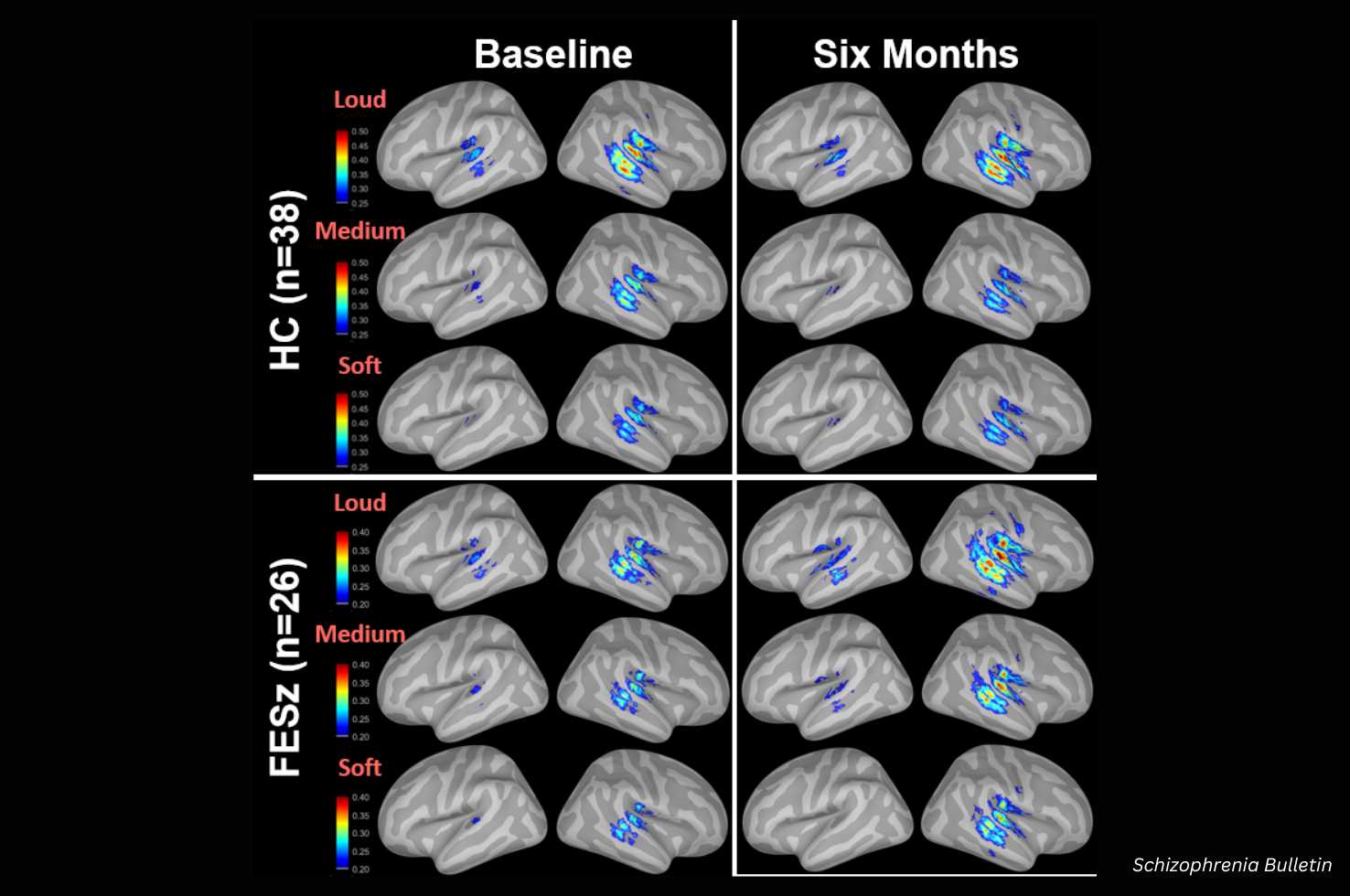
To improve our understanding of the pathophysiology of negative symptoms in schizophrenia and its longitudinal progression, investigators including Alfredo Sklar, MD, PhD (Assistant Professor of Psychiatry); Brian Coffman, PhD (Research Assistant Professor of Psychiatry); and Dean Salisbury, PhD (Professor of Psychiatry), from Pitt Psychiatry, assessed changes in auditory cortex dynamic range—the scaling of neurophysiological responses to changes in stimulus intensity—over a six-month period during early-stage psychotic illness. The scientists used magnetoencephalography during binaural presentation of tones in 26 individuals with first-episode psychosis and 38 unaffected comparison subjects. 

“While disruptions in auditory processing have been well-documented in schizophrenia, the sensitivity of the auditory cortex to variations in stimulus intensity remained understudied. Given the importance of fluctuations in tone and intensity to emotional communication in spoken language, we felt this line of investigation would provide valuable insights into debilitating social deficits observed in schizophrenia,” said Dr. Sklar, the study’s first author.

The investigators found that individuals with first-episode psychosis exhibited a blunted response to increasing tone intensity relative to the unaffected comparison group. While this deficit did not change over time at the group level, recovery of right hemisphere auditory cortex dynamic among individuals with first-episode psychosis was associated with reduced negative symptoms at follow-up. Diminished dynamic range was also associated with poorer community functioning and cognitive performance at baseline and increased negative symptoms at baseline and follow-up.

“When individuals first experience psychosis, their auditory system does not track sound intensity well, so everything may seem muted. Not only do sounds seems softer, but decoding the subtle cues in language is likely harder. Auditory dynamic range improves in individuals that get better in the first year of treatment, which suggests that directly treating auditory processing may help improve poor social functioning in early psychosis,” said Dr. Salisbury, senior author of the study.

Longitudinal Investigation of Auditory Dynamic Range Deficits in Early Psychosis and its Relationship to Negative Symptoms
Sklar AL, Matinrazm S, Ren X, Chlpka L, Curtis M, Coffman BA, Salisbury DF.

Schizophrenia Bulletin, Volume 49, Issue 6, November 2023, Pages 1508–1517, https://doi.org/10.1093/schbul/sbad072

University of Pittsburgh logo

Stay connected

  • LinkedIn
  • Bluesky
  • Instagram
  • Facebook
  • Threads

Location

Thomas Detre Hall
3811 O'Hara Street
Pittsburgh, PA 15213
  • Contact Us

Related Websites

  • medschool.pitt.edu
  • pitt.edu

Explore

  • Find People
  • Education
  • Research
  • Patient Care
  • Community & Culture
  • About Us
  • News and Events

Information for

  • Faculty & Staff
  • Prospective Trainees
  • Investigators
  • Patients & Families

Intranet Sites

  • Psy Hub for faculty (requires UPMC log-in and UPMC computer or access through MyApps)
  • Postdoc Portal Postdoc Portal for postdoctoral trainees
  • Office of Grants and Contracts (OGC) website accessible on internal network only

Join Our Newsletter

Stay up to date on department and faculty happenings.

University of Pittsburgh Department of Psychiatry mailing list Fill in the form to subscribe to the mailing list.

Psychiatry Advances Podcast

Covering Innovative research and patient-centered programs.

Listen to Podcast

© 2026 University of Pittsburgh Department of Psychiatry