
Pitt Psychiatry Awarded $33.5M National Institute on Aging Program Project Grant Focused on the Pathological and Clinical Progression of Alzheimer’s Disease
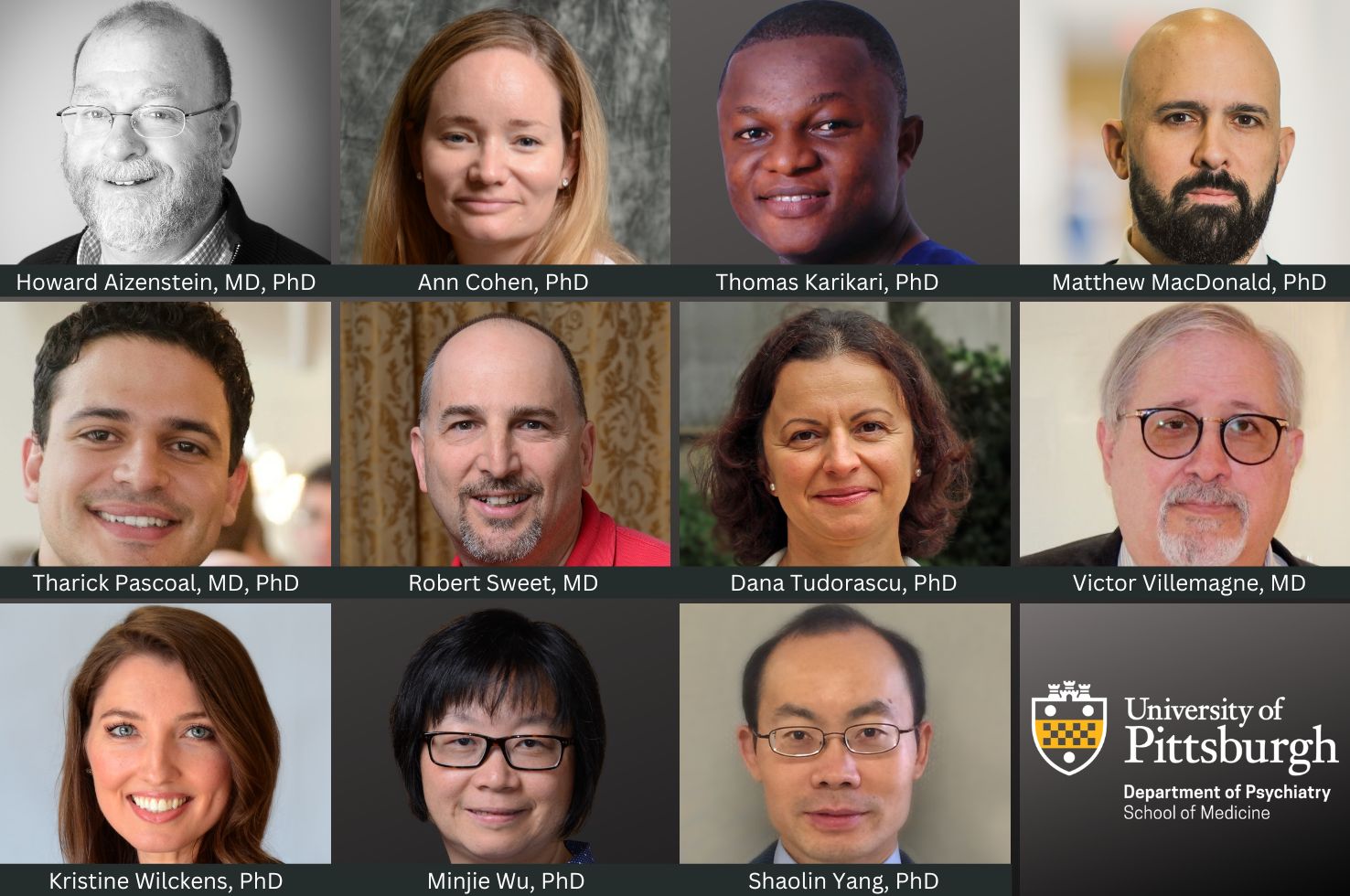
The National Institute on Aging (NIA) has awarded the University of Pittsburgh Department of Psychiatry a Program Project Grant (PPG) renewal for “The role of astrogliosis in aging and the pathological and clinical progression of Alzheimer's disease.” The Alzheimer’s PPG will be led by a multiple principal investigator team including Ann Cohen, PhD (Associate Professor of Psychiatry), Howard Aizenstein, MD, PhD (Charles F. Reynolds III and Ellen G. Detlefsen Endowed Chair in Geriatric Psychiatry and Professor of Bioengineering and Clinical and Translational Science), Victor Villemagne, MD (Professor of Psychiatry), and Milos Ikonomovic, MD (Professor of Neurology and Psychiatry).
During the pre-clinical and prodromal phases of Alzheimer’s disease, there is a complex interaction of clinical and subclinical cerebral and systemic factors that can convey either vulnerability or resilience to the underlying pathologies of the disease. A major factor contributing to degenerative processes in the Alzheimer’s disease pathophysiological spectrum is gliosis-associated inflammation, but until recently, examining neuroinflammation in the living brain has been exceptionally challenging.
To overcome the obstacles of assessing neuroinflammation in people with Alzheimer’s disease and to improve our understanding of the pathophysiological mechanisms that lead to the development of this disease, the Alzheimer’s PPG will characterize a novel positron emission tomography (PET) tracer, SMBT-1, which has high binding affinity for the enzyme monoamine oxidase B (MAO-B), a proxy of astrogliosis. Astrogliosis is a phenomenon associated with neuroinflammation and related pathological processes including amyloid-β (Aβ) deposition, alterations in cerebral blood flow, and impairments in blood brain barrier integrity in Alzheimer’s disease. Thus, this novel tracer is well suited to achieve the PPG goals.
“With the renewal of this PPG, we are recruiting a new cohort of study participants and focusing on community-based recruitment and underrepresented groups, to better represent the Pittsburgh region,” said Dr. Cohen. “In addition, we’re using a new PET tracer to detect inflammation—we’re one of just a few groups worldwide using this tracer—complemented with state-of-the-art blood-based biomarkers.”
Four related projects will explore the relationship of astrogliosis to Alzheimer’s pathology and risk factors using a combination of state-of-the-art neuroimaging, clinical, blood biomarker, and neuropathological tools:
Project 1 will test the hypothesis that astrogliosis augments, either directly or independently, the effects of Aβ and tau pathology, as well as the effects of cardiovascular disease on neurodegeneration and cognition. Dr. Victor Villemagne will serve as project lead, with Oscar Lopez, MD, FAAN (Professor of Neurology, Psychiatry, & Clinical and Translational Sciences), serving as project co-lead.
Project 2 will test the hypothesis that astrogliosis mediates the association between health risk factors (cardiovascular risk factors and sleep) and amyloid and tau pathology. Dr. Cohen will serve as project lead, with Kristine Wilckens, PhD (Assistant Professor of Psychiatry), as project co-lead. Dr. Oscar Lopez and Elizabeth Shabban, PhD, MS, MPH (Assistant Professor of Epidemiology), will serve as co-investigators.
Project 3, led by Dr. Howard Aizenstein, with Davneet Minhas, PhD (Research Instructor of Radiology), serving as co-lead, will utilize novel 7T magnetic resonance imaging to assess the role of brain fluid dynamics in relation to astrogliosis, cerebrovascular alterations, and Alzheimer’s disease pathology. Charles Laymon, PhD (Research Instructor of Radiology), Shaolin Yang, PhD (Assistant Professor of Psychiatry and Bioengineering), and Tamer Ibrahim, PhD (Professor of Bioengineering, Radiology, and Psychiatry), will serve as co-investigators.
Project 4 will use the existing Alzheimer’s Disease Research Center and PPG banked brain tissue samples to characterize regional differences in SMBT-1 autoradiography and in vitro binding in relation to fine-grained immunohistochemical and biochemical analyses of MAO-B/GFAP astrogliosis, amyloid and tau pathology, vascular pathology, and synaptic markers in Alzheimer’s disease, and it will ultimately characterize SMBT-1 PET in relation to neuropathology in postmortem brains from PPG participants who come to autopsy.
This project will be led by Dr. Milos Ikonomovic, with Dr. Tamer Ibrahim, Julia Kofler, MD (Associate Professor of Pathology), Matthew MacDonald, PhD (Associate Professor of Psychiatry), Thomas Pearce, MD, PhD (Assistant Professor of Pathology), Robert Sweet, MD (UPMC Endowed Professor in Psychiatric Neuroscience and Professor of Neurology and Clinical and Translational Science), and Dr. Victor Villemagne serving as co-investigators.
The Alzheimer’s PPG additionally includes four cores:
Clinical Core:
Core Lead: Beth Snitz, PhD (Associate Professor of Neurology)
Core Co-lead: Neelesh Nadkarni, MD, PhD (Associate Professor of Medicine and Neurology)
Co-investigator: Dr. Oscar Lopez
Co-investigator: Dr. Kristine Wilckens
Imaging Biomarker Core:
Core Lead: Brian Lopresti, MSNE (Research Assistant Professor of Radiology)
Core Co-lead: Charles Laymon, PhD (Research Assistant Professor, Department of Radiology PET Center)
Co-investigator: Dr. Tamer Ibrahim
Co-investigator: Dr. Davneet Minhas
Co-investigator: Dr. Victor Villemagne
Co-investigator: Minjie Wu, PhD (Assistant Professor of Psychiatry)
Fluid Biomarker Core:
Core Lead: Thomas Karikari, PhD (Assistant Professor of Psychiatry)
Core Co-lead: Tharick Pascoal, MD, PhD (Assistant Professor of Psychiatry and Neurology)
Biostatistics and Data Management Core:
Core Lead: Dana Tudorascu, PhD (Associate Professor of Psychiatry and Biostatistics)
Co-investigator: Yue-Fang Chang, PhD (Research Associated Professor of Neurological Surgery and Epidemiology)
Co-investigator: Lan Yu, PhD (Associate Professor of Medicine, Psychiatry, and Clinical and Translational Science)
Co-investigator: Tingting Zhang, PhD (Professor of Statistics)