
University of Pittsburgh logo
Department of Psychiatry
University of Pittsburgh logo
Information for You
  • Faculty & Staff
  • Prospective Trainees
  • Investigators
  • Patients & Families
Our People
Menu
  • Education
    • Education Overview
    • Residency & Fellowships
    • Research Training
    • Medical Student Education
    • Clinical Psychology Internship
    • Clinician Career Development
  • Research
    • Research Overview
    • Research Faculty
    • Research Training
    • Investigator Resources
    • Health Equity Research
    • Participate in Research
  • Patient Care
    • Patient Care Overview
    • Access to Care
    • Clinical Services Overview
    • Clinical Faculty
    • Resources for Clinicians
  • Community & Culture
    • Community & Culture Overview
    • Leadership & Advisory Council
    • Research Equity & Community Health (REACH)
    • Community & Partnership
    • Community News
  • About Us
    • About Us Overview
    • Chair's Message
    • Our People
    • Our History, Our Present, & Our Future
    • Life in Pittsburgh
  • News & Events
    • News & Events Overview
    • News
    • Events
  • Information for You
    • Faculty & Staff
    • Prospective Trainees
    • Investigators
    • Patients & Families
  • Our People

Main menu

  • Education
    • Residency & Fellowships
      • Residency Training
      • Training Pathways & Concentrations
      • Clinical Fellowships
      • Our Clinical Learning Environment
      • Our Leadership
      • Our Chief Residents
      • Our Residents
    • Research Training
      • Undergraduate & Graduate Student Training
      • Medical Student Research
      • Research During Residency
      • Postdoctoral Training
      • Medical Student Education
      • Clinical Psychology Internship
      • Clinician Career Development
  • Research
    • Research Training
      • Undergraduate & Graduate
      • Medical Student Research
      • Research During Residency
      • Postdoctoral Training
    • Investigator Resources
      • Research Day
      • Research Review Committee
      • Assessment Instruments
    • Health Equity Research
      • REACH Collaborative
      • Research Faculty
      • Participate in Research
  • Patient Care
      • Access to Care
      • Clinical Services Overview
      • Clinical Faculty
      • Resources for Clinicians
  • Community & Culture
  • About Us
    • Our People
      • Faculty
      • Staff
      • Emeritus Faculty
      • Chair's Message
      • Our History, Our Present, & Our Future
      • Life in Pittsburgh
  • News & Events
      • News
      • Events
  • Search

Breadcrumb menu

  1. Home
  2. News
  • December 14, 2017
  • Share on LinkedIn
  • Share on Bluesky
  • Share on Facebook
  • Share on Threads
  • Share via email

Dr. Rebecca Thurston’s Research Featured in the Journal Menopause and in Forbes Magazine
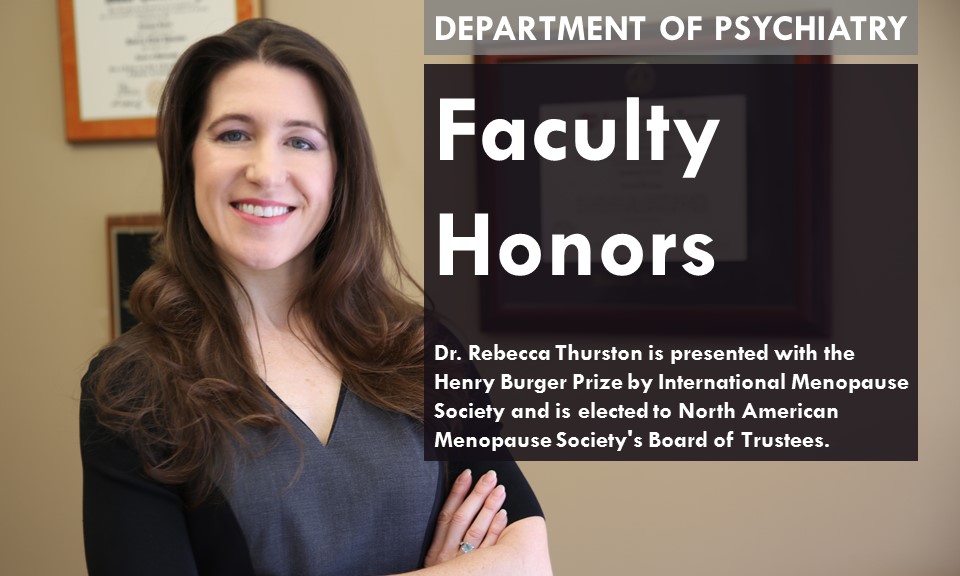
Dr. Rebecca Thurston’s Research featured in Menopause and Forbes Magazine

Findings by Dr. Rebecca Thurston indicate that traumatic experiences such as being in a serious accident or natural disaster, witnessing a shooting, or experiencing sexual assault or harassment could affect the cardiovascular system. The results of this study were presented by Dr. Thurston at the North American Menopause Society (NAMS) annual meeting in Philadelphia, PA and appear in the December issue of the journal Menopause. Her work was also featured in Forbes magazine’s article ”Being Sexually Harassed May Have Long-Term Physical Consequences”, and is particularly relevant in light of the recent sexual harassment allegations against high-profile individuals, catastrophic weather events, and mass shootings.

Dr. Thurston, Director of the Women's Behavioral Health Laboratory and Professor of Psychiatry, Psychology, and Epidemiology, determined how experiencing trauma may affect blood vessels and the cardiovascular system. Members of the team include University of Pittsburgh researchers Yuefang Chang, PhD; Emma Barinas Mitchell, PhD; and Karen Matthews, PhD, as well as Karestan Koenen, PhD, Harvard University and Roland von Känel, MD, University of Bern. They recruited nonsmoking, middle-aged women with no evidence of clinical cardiovascular disease and identified whether they had experienced any major emotional trauma, including suffering sexual harassment or unwanted sexual contact. The majority of these women reported that they had experienced at least one trauma, with unwanted sexual contact the most common type of trauma.The researchers then measured each subject's brachial artery flow mediated dilation, a measure of blood vessel endothelial function, and found that those who had more traumatic experiences had poorer functioning blood vessels. Women reporting a higher number of traumatic experiences (particularly three or more) had poorer blood vessel function, which can result in susceptibility to later cardiovascular disease. Potential confounders such as smoking, obesity, blood pressure, economic status, or medication use did not explain the associations between trauma and endothelial function. 

"These findings suggest that trauma prevention may be cardiovascular risk reduction," Dr. Thurston said. "When we think of cardiovascular disease prevention, we tend to think of biomedical risk factors such as lipids or blood pressure. We also need to think of psychosocial factors such as depression, anxiety, or trauma." 

Dr. Thurston is recognized nationally as a leader in the field of women’s health, particularly in the areas of menopause and the risk for cardiovascular disease in women. She is a member of the NAMS Board of Trustees and was appointed as a member of the NAMS Executive Committee at the annual meeting.

University of Pittsburgh logo

Stay connected

  • LinkedIn
  • Bluesky
  • Instagram
  • Facebook
  • Threads

Location

Thomas Detre Hall
3811 O'Hara Street
Pittsburgh, PA 15213
  • Contact Us

Related Websites

  • medschool.pitt.edu
  • pitt.edu

Explore

  • Find People
  • Education
  • Research
  • Patient Care
  • Community & Culture
  • About Us
  • News and Events

Information for

  • Faculty & Staff
  • Prospective Trainees
  • Investigators
  • Patients & Families

Intranet Sites

  • Psy Hub for faculty (requires UPMC log-in and UPMC computer or access through MyApps)
  • Postdoc Portal Postdoc Portal for postdoctoral trainees
  • Office of Grants and Contracts (OGC) website accessible on internal network only

Join Our Newsletter

Stay up to date on department and faculty happenings.

University of Pittsburgh Department of Psychiatry mailing list Fill in the form to subscribe to the mailing list.

Psychiatry Advances Podcast

Covering Innovative research and patient-centered programs.

Listen to Podcast

© 2026 University of Pittsburgh Department of Psychiatry