
University of Pittsburgh logo
Department of Psychiatry
University of Pittsburgh logo
Information for You
  • Faculty & Staff
  • Prospective Trainees
  • Investigators
  • Patients & Families
Our People
Menu
  • Education
    • Education Overview
    • Residency & Fellowships
    • Research Training
    • Medical Student Education
    • Clinical Psychology Internship
    • Clinician Career Development
  • Research
    • Research Overview
    • Research Faculty
    • Research Training
    • Investigator Resources
    • Health Equity Research
    • Participate in Research
  • Patient Care
    • Patient Care Overview
    • Access to Care
    • Clinical Services Overview
    • Clinical Faculty
    • Resources for Clinicians
  • Community & Culture
    • Community & Culture Overview
    • Leadership & Advisory Council
    • Research Equity & Community Health (REACH)
    • Community & Partnership
    • Community News
  • About Us
    • About Us Overview
    • Chair's Message
    • Our People
    • Our History, Our Present, & Our Future
    • Life in Pittsburgh
  • News & Events
    • News & Events Overview
    • News
    • Events
  • Information for You
    • Faculty & Staff
    • Prospective Trainees
    • Investigators
    • Patients & Families
  • Our People

Main menu

  • Education
    • Residency & Fellowships
      • Residency Training
      • Training Pathways & Concentrations
      • Clinical Fellowships
      • Our Clinical Learning Environment
      • Our Leadership
      • Our Chief Residents
      • Our Residents
    • Research Training
      • Undergraduate & Graduate Student Training
      • Medical Student Research
      • Research During Residency
      • Postdoctoral Training
      • Medical Student Education
      • Clinical Psychology Internship
      • Clinician Career Development
  • Research
    • Research Training
      • Undergraduate & Graduate
      • Medical Student Research
      • Research During Residency
      • Postdoctoral Training
    • Investigator Resources
      • Research Day
      • Research Review Committee
      • Assessment Instruments
    • Health Equity Research
      • REACH Collaborative
      • Research Faculty
      • Participate in Research
  • Patient Care
      • Access to Care
      • Clinical Services Overview
      • Clinical Faculty
      • Resources for Clinicians
  • Community & Culture
  • About Us
    • Our People
      • Faculty
      • Staff
      • Emeritus Faculty
      • Chair's Message
      • Our History, Our Present, & Our Future
      • Life in Pittsburgh
  • News & Events
      • News
      • Events
  • Search

Breadcrumb menu

  1. Home
  2. News
  • May 8, 2025
  • Share on LinkedIn
  • Share on Bluesky
  • Share on Facebook
  • Share on Threads
  • Share via email

Biological Psychiatry – The Impact of Intravenous Ketamine on Attentional Bias: Probing Mechanisms of Rapid-Acting Antidepressant Effects in Two Clinical Studies
Biological Psychiatry

Intravenous ketamine produces reliable, fast-acting, and potent antidepressant effects even among individuals with treatment-resistant depression. Ketamine can also be a powerful experimental tool to provide a more precise evaluation of neurocognitive mechanisms underlying reduction in depression symptoms. 

Cognitive theorists of depression have long posited that systematic alterations in attentional bias (giving selective attention to positive or negative information) are key neurocognitive contributors to chronically depressed mood. The relationship between depression and attentional bias is critical because attentional bias can draw attention toward negative information and away from benign information. This attention toward negative information leads to a skewed integration of information across neurocognitive systems, resulting in predominantly negative recollections and interpretations of the self, others, and the world, which again reinforces sustained focus on negative information and persistence of depressed mood.

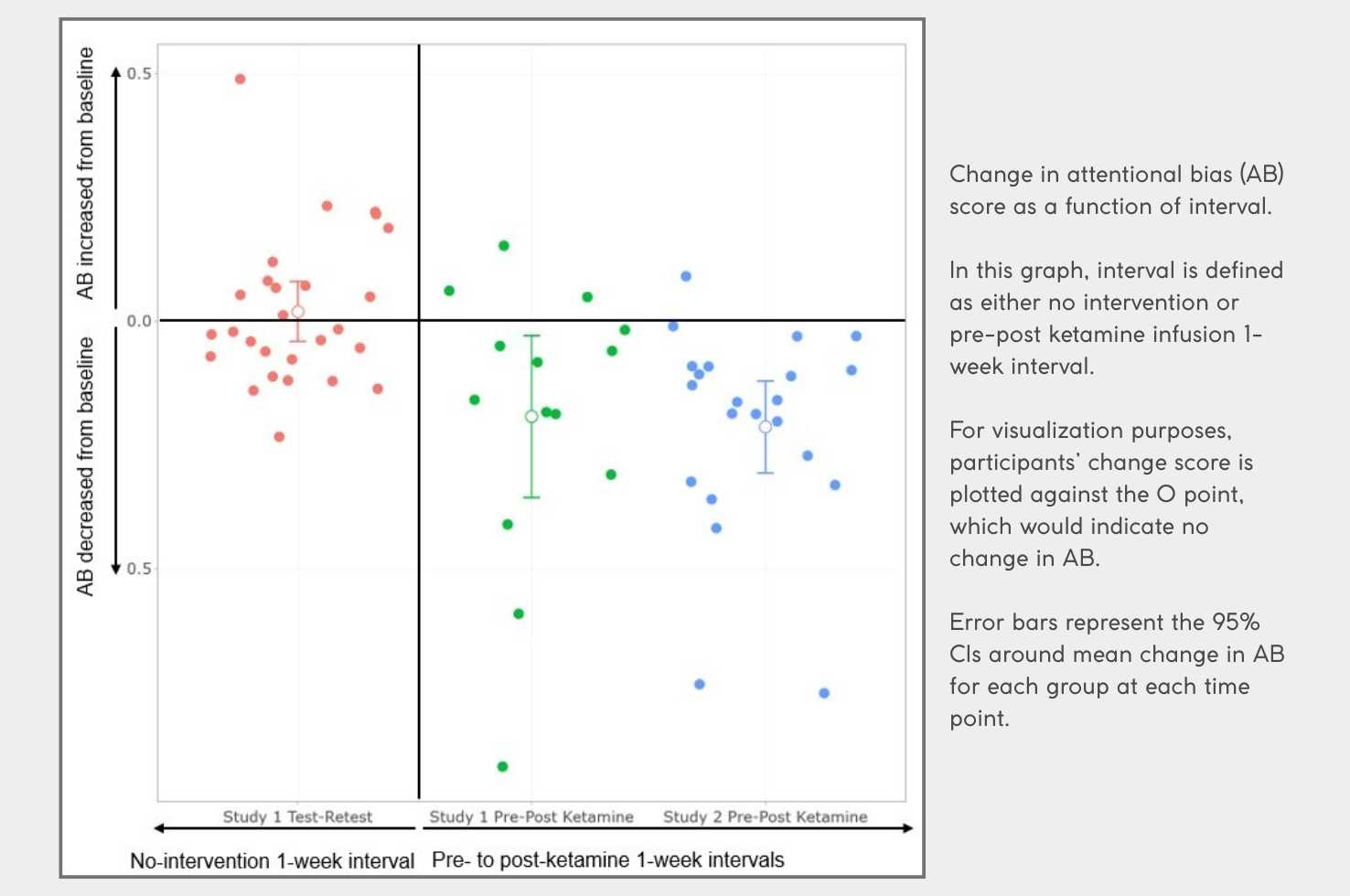
To assess the patterns of attentional bias that characterize depression, investigators including Mary Woody, PhD (Assistant Professor of Psychiatry); Neil Jones, PhD (Associate Professor of Psychiatry and Psychology); Marta Peciña, MD, PhD (Associate Professor of Psychiatry); Kymberly Young, PhD (Associate Professor of Psychiatry); Sharvari Shivanekar, MD (Assistant Professor of Psychiatry); Manivel Rengasamy, MD (Assistant Professor of Psychiatry); and Rebecca Price, PhD (Associate Professor of Psychiatry and Psychology), from Pitt Psychiatry, leveraged a novel measurement of attentional bias in two separate studies. In the first study, adults with depression completed the task at baseline, then again after one week and one month; a subset of participants also performed the task 24 hours after receiving a ketamine infusion. In the second study, participants completed the task before receiving ketamine infusion, and again 24 hours post-ketamine. 

The scientists reported evidence demonstrating that intravenous ketamine rapidly and consistently improves attentional bias for sad stimuli, suggesting that attentional processes may serve as a cognitive mechanism that underlies the rapid-acting antidepressant effects of the drug. In addition, the novel task exhibited strong test-retest reliability and convergent validity, suggesting that it both reliably measured attentional bias and these measurements were also associated with depressive symptoms. This finding further validated the task’s value as a tool for exploring ketamine’s effects on attentional bias. 

“In two separate studies, we found that a single dose of ketamine helped people with moderate to severe depression pay less attention to sad information and more to positive and neutral information. This effect was reliable and may help explain how ketamine provides such rapid antidepressant relief. Because ketamine’s effects often wear off within days, these findings also offer clues for developing new treatments that could help sustain its effects. Those future implications are especially exciting, as this work was partially supported by a Pitt Psychiatry Constellation Award designed to do exactly that: spark new ideas and future research,” said Dr. Woody, corresponding author of the study, recently published in Biological Psychiatry.

The Impact of Intravenous Ketamine on Attentional Bias: Probing Mechanisms of Rapid-Acting Antidepressant Effects in Two Clinical Studies
Woody ML, Rohac R, Cooper I, Griffo A, McDonald N, Spotts C, Fournier J, Jones N, Peciña M, Young K, Shivanekar S, Rengasamy M, Grafton B, Price RB.
Biological Psychiatry, Volume 97, Issue 8, 835 – 842.
 

University of Pittsburgh logo

Stay connected

  • LinkedIn
  • Bluesky
  • Instagram
  • Facebook
  • Threads

Location

Thomas Detre Hall
3811 O'Hara Street
Pittsburgh, PA 15213
  • Contact Us

Related Websites

  • medschool.pitt.edu
  • pitt.edu

Explore

  • Find People
  • Education
  • Research
  • Patient Care
  • Community & Culture
  • About Us
  • News and Events

Information for

  • Faculty & Staff
  • Prospective Trainees
  • Investigators
  • Patients & Families

Intranet Sites

  • Psy Hub for faculty (requires UPMC log-in and UPMC computer or access through MyApps)
  • Postdoc Portal Postdoc Portal for postdoctoral trainees
  • Office of Grants and Contracts (OGC) website accessible on internal network only

Join Our Newsletter

Stay up to date on department and faculty happenings.

University of Pittsburgh Department of Psychiatry mailing list Fill in the form to subscribe to the mailing list.

Psychiatry Advances Podcast

Covering Innovative research and patient-centered programs.

Listen to Podcast

© 2026 University of Pittsburgh Department of Psychiatry