University of Pittsburgh logo
Department of Psychiatry
University of Pittsburgh logo
Information for You
  • Faculty & Staff
  • Prospective Trainees
  • Investigators
  • Patients & Families
Our People
Menu
  • Education
    • Education Overview
    • Residency & Fellowships
    • Research Training
    • Medical Student Education
    • Clinical Psychology Internship
    • Clinician Career Development
  • Research
    • Research Overview
    • Research Faculty
    • Research Training
    • Investigator Resources
    • Health Equity Research
    • Participate in Research
  • Patient Care
    • Patient Care Overview
    • Access to Care
    • Clinical Services Overview
    • Clinical Faculty
    • Resources for Clinicians
  • Community & Culture
    • Community & Culture Overview
    • Leadership & Advisory Council
    • Research Equity & Community Health
    • Community & Partnership
    • Community News
    • Community Awards & Accolades
  • About Us
    • About Us Overview
    • Chair's Message
    • Our People
    • Our History, Our Present, & Our Future
    • Life in Pittsburgh
  • News & Events
    • News & Events Overview
    • News
    • Events
  • Information for You
    • Faculty & Staff
    • Prospective Trainees
    • Investigators
    • Patients & Families
  • Our People

Main menu

  • Education
    • Residency & Fellowships
      • Residency Training
      • Training Pathways & Concentrations
      • Clinical Fellowships
      • Our Clinical Learning Environment
      • Our Leadership
      • Our Chief Residents
      • Our Residents
    • Research Training
      • Undergraduate & Graduate Student Training
      • Medical Student Research
      • Research During Residency
      • Postdoctoral Training
      • Medical Student Education
      • Clinical Psychology Internship
      • Clinician Career Development
  • Research
    • Research Training
      • Undergraduate & Graduate
      • Medical Student Research
      • Research During Residency
      • Postdoctoral Training
    • Investigator Resources
      • Research Day
      • Research Review Committee
      • Assessment Instruments
    • Health Equity Research
      • REACH Collaborative
      • Research Faculty
      • Participate in Research
  • Patient Care
      • Access to Care
      • Clinical Services Overview
      • Clinical Faculty
      • Resources for Clinicians
  • Community & Culture
      • Leadership & Advisory Council
      • Research Equity & Community Health
      • Community & Partnership
      • Community News
      • Community Awards & Accolades
  • About Us
    • Our People
      • Faculty
      • Staff
      • Emeritus Faculty
      • Chair's Message
      • Our History, Our Present, & Our Future
      • Life in Pittsburgh
  • News & Events
      • News
      • Events
  • Search

Breadcrumb menu

  1. Home
  2. News
  • May 3, 2021
  • Share on LinkedIn
  • Share on Bluesky
  • Share on Facebook
  • Share on Threads
  • Share via email

Translational Psychiatry: New Research on Dopaminergic Modulation of Pancreatic Hormone Secretion
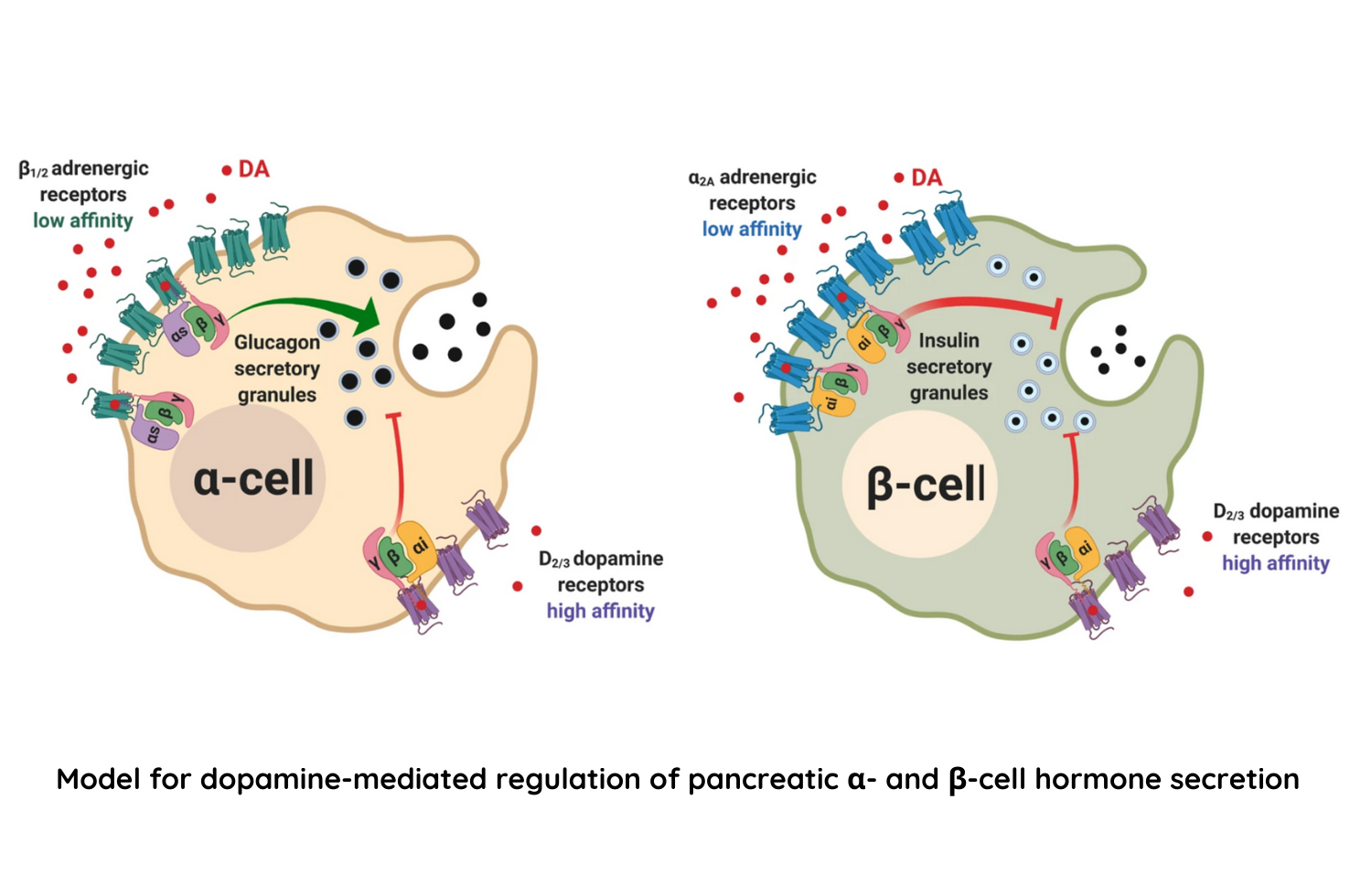
Freyberg & Colleagues Translational Psychiatry 2021

Antipsychotic drugs can cause metabolic dysfunction that increases the risk for developing type 2 diabetes. These medications block dopamine D2-like receptors, including D2 and D3 receptors, which are expressed in pancreatic β-cells (in addition to the central nervous system). Dopamine and norepinephrine are catecholamines that act in the pancreas as peripheral regulators of metabolism. Pancreatic catecholamine signaling has also been increasingly implicated as a mechanism responsible for the metabolic disturbances produced by antipsychotic drugs. 

In Translational Psychiatry, investigators including Despoina Aslanoglou, PhD (postdoctoral scholar) and Zachary Freyberg, MD, PhD (Assistant Professor of Psychiatry and Cell Biology) examined the mechanisms by which catecholamines modulate pancreatic hormone release.

“We wanted to understand how antipsychotic drugs, which target dopamine system in the brain, cause metabolic side effects in patients that receive these medications,” said Dr. Aslanoglou, the study’s first author. “Our work could set the basis for defining the theory of dopamine in metabolic dysfunction, and our findings can be useful for future drug design for both psychiatric and metabolic disorders.” 

To evaluate whether human and mouse α-cells and β-cells express the machinery of catecholamine biosynthesis and catabolism, the team analyzed an RNA-sequencing data set from human α-cells and β-cells, alongside a comparable available RNA- sequencing data set from mouse α-cells and β-cells.

Results from the experiment demonstrated that human and mouse pancreatic α- and β-cells express the catecholamine biosynthetic and signaling machinery, and that α-cells synthesize dopamine de novo. This locally produced pancreatic dopamine signals via both α- and β-cell adrenergic and dopaminergic receptors with different affinities to regulate glucagon and insulin release. The team additionally found that dopamine functions as a biased agonist at α2A-adrenergic receptors, preferentially signaling via the canonical G protein-mediated pathway. This ability of dopamine to signal differently on dopaminergic receptors versus adrenergic receptors may be critical for finetuning the regulation of blood sugar which is essential for life.

“Our work shows that dopamine signals not only in the brain, but also directly in the periphery and antipsychotic drugs disrupt this peripheral signaling, particularly in the pancreas. This may provide an important mechanism for how these medications cause insulin resistance, and eventually diabetes. These findings pave the way for new more effective treatments for mitigating or even reversing metabolic disturbances produced by antipsychotic drugs and may even lead to better medications for treating diabetes,” said Dr. Freyberg, senior author of the study.

Dopamine regulates pancreatic glucagon and insulin secretion via adrenergic and dopaminergic receptors
Aslanoglou D, Bertera S, Sánchez-Soto M, Free RB, Lee J, Zong W, Xue X, Shrestha S, Brissova M, Logan RW, Wollheim CB, Trucco M, Yechoor VK, Sibley DR, Bottino R, Freyberg Z.

Translational Psychiatry 11, 59 (2021). https://doi.org/10.1038/s41398-020-01171-z c

University of Pittsburgh logo

Stay connected

  • LinkedIn
  • Bluesky
  • Instagram
  • Facebook
  • Threads

Location

Thomas Detre Hall
3811 O'Hara Street
Pittsburgh, PA 15213
  • Contact Us

Related Websites

  • medschool.pitt.edu
  • pitt.edu

Explore

  • Find People
  • Education
  • Research
  • Patient Care
  • Community & Culture
  • About Us
  • News and Events

Information for

  • Faculty & Staff
  • Prospective Trainees
  • Investigators
  • Patients & Families

Intranet Sites

  • Psy Hub for faculty (requires UPMC log-in and UPMC computer or access through MyApps)
  • Postdoc Portal Postdoc Portal for postdoctoral trainees
  • Office of Grants and Contracts (OGC) website accessible on internal network only

Join Our Newsletter

Stay up to date on department and faculty happenings.

University of Pittsburgh Department of Psychiatry mailing list Fill in the form to subscribe to the mailing list.

Psychiatry Advances Podcast

Covering Innovative research and patient-centered programs.

Listen to Podcast

© 2026 University of Pittsburgh Department of Psychiatry