University of Pittsburgh logo
Department of Psychiatry
University of Pittsburgh logo
Information for You
  • Faculty & Staff
  • Prospective Trainees
  • Investigators
  • Patients & Families
Our People
Menu
  • Education
    • Education Overview
    • Residency & Fellowships
    • Research Training
    • Medical Student Education
    • Clinical Psychology Internship
    • Clinician Career Development
  • Research
    • Research Overview
    • Research Faculty
    • Research Training
    • Investigator Resources
    • Health Equity Research
    • Participate in Research
  • Patient Care
    • Patient Care Overview
    • Access to Care
    • Clinical Services Overview
    • Clinical Faculty
    • Resources for Clinicians
  • Community & Culture
    • Community & Culture Overview
    • Leadership & Advisory Council
    • Research Equity & Community Health
    • Community & Partnership
    • Community News
    • Community Awards & Accolades
  • About Us
    • About Us Overview
    • Chair's Message
    • Our People
    • Our History, Our Present, & Our Future
    • Life in Pittsburgh
  • News & Events
    • News & Events Overview
    • News
    • Events
  • Information for You
    • Faculty & Staff
    • Prospective Trainees
    • Investigators
    • Patients & Families
  • Our People

Main menu

  • Education
    • Residency & Fellowships
      • Residency Training
      • Training Pathways & Concentrations
      • Clinical Fellowships
      • Our Clinical Learning Environment
      • Our Leadership
      • Our Chief Residents
      • Our Residents
    • Research Training
      • Undergraduate & Graduate Student Training
      • Medical Student Research
      • Research During Residency
      • Postdoctoral Training
      • Medical Student Education
      • Clinical Psychology Internship
      • Clinician Career Development
  • Research
    • Research Training
      • Undergraduate & Graduate
      • Medical Student Research
      • Research During Residency
      • Postdoctoral Training
    • Investigator Resources
      • Research Day
      • Research Review Committee
      • Assessment Instruments
    • Health Equity Research
      • REACH Collaborative
      • Research Faculty
      • Participate in Research
  • Patient Care
      • Access to Care
      • Clinical Services Overview
      • Clinical Faculty
      • Resources for Clinicians
  • Community & Culture
      • Leadership & Advisory Council
      • Research Equity & Community Health
      • Community & Partnership
      • Community News
      • Community Awards & Accolades
  • About Us
    • Our People
      • Faculty
      • Staff
      • Emeritus Faculty
      • Chair's Message
      • Our History, Our Present, & Our Future
      • Life in Pittsburgh
  • News & Events
      • News
      • Events
  • Search

Breadcrumb menu

  1. Home
  2. News
  • April 6, 2018
  • Share on LinkedIn
  • Share on Bluesky
  • Share on Facebook
  • Share on Threads
  • Share via email

Findings by Dr. Guillermo Gonzalez-Burgos and Dr. David Lewis Indicate that NMDAR Activation Enhances Inhibition of PCs by PVBCs 
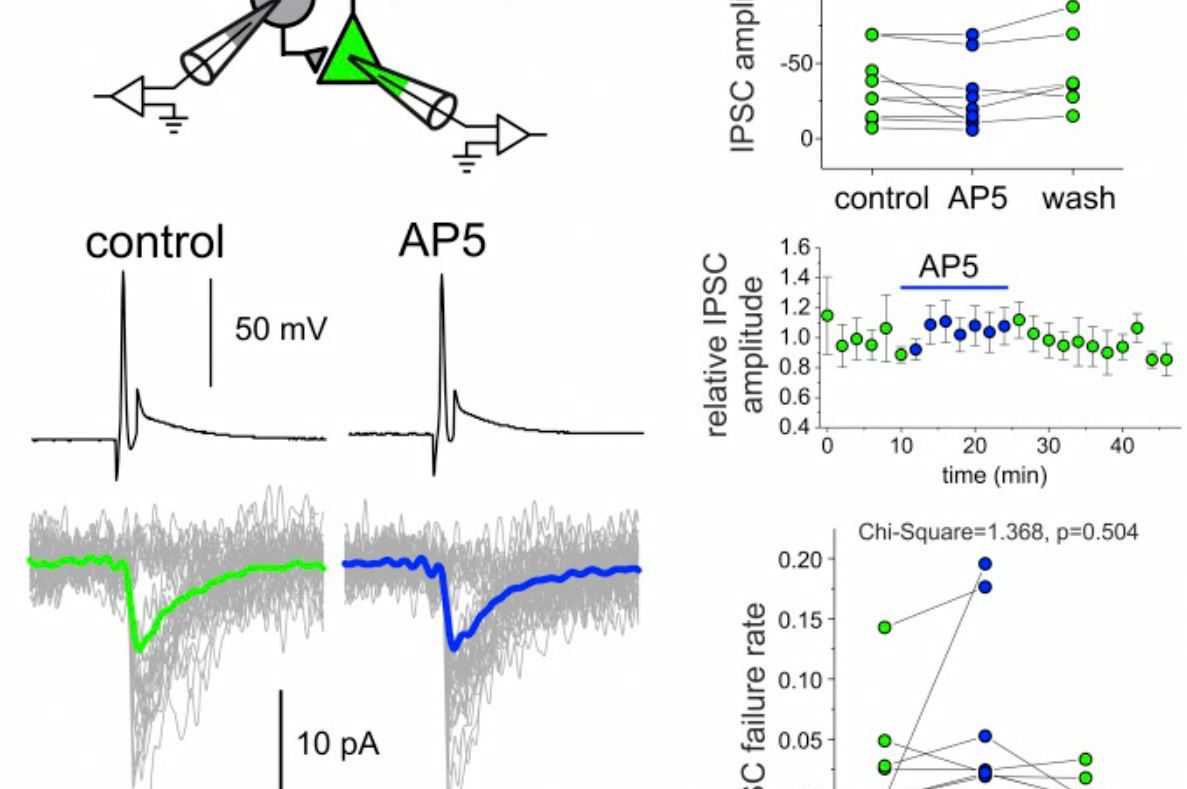
Gonzalez-Burgos and Colleagues Biol Psych 2018 Figure

Understanding the mechanisms by which N-methyl-D-aspartate receptors (NMDARs) regulate cortical circuit function is crucial for testing hypotheses that NMDAR hypofunction is involved in the pathophysiology of schizophrenia. Recent studies reveal that presynaptic NMDARs control transmitter release at cortical synapses, suggesting novel mechanisms of NMDAR action in cortical circuits. If presynaptic NMDARs enhance gamma-aminobutyric acid (GABA) release in cortex, they could participate in NMDAR-dependent pyramidal cell (PC) disinhibition, a mechanism hypothesized to contribute to schizophrenia pathophysiology in previous studies.

Using whole-cell recordings from synaptically connected pairs in brain slices from mouse prefrontal cortex (PFC), Guillermo Gonzalez-Burgos, PhD, Associate Professor of Psychiatry, and David Lewis, MD, Department Chair, together with colleagues from the Department’s Translational Neuroscience Program, examined whether presynaptic NMDAR effects enhance GABA release at parvalbumin-positive basket cell- (PVBC-) to PC synapses and if NMDAR activation affects PVBC-to-PC inhibition in a manner consistent with a presynaptic mechanism. The data suggest that NMDAR stimulation enhanced the strength of PVBC-to-PC synapses, and several lines of evidence suggest that this effect is mediated by presynaptic NMDAR-mediated regulation of GABA release. Interestingly, the effects observed in brain slices acutely maintained in vitro suggest that the functional impact of this presynaptic effect depends on the activity state of the PFC network. More specifically, the data indicate that the NMDAR-mediated increase in synaptic strength at PVBC-to-PC synapses enhances the gain of inhibition specifically during high network activity states driven by recurrent excitation such as those presumably observed in PFC circuits during working memory tasks.

Therefore, the data suggest that, independent of causing PC disinhibitions, NMDAR hypofunction at PVBC-to-PC synapses in schizophrenia might disrupt a crucial mechanism that normally enhances PC inhibition when the PFC network is engaged in working memory-related operations. 

“Currently, empirical support for NMDAR hypofunction in PVBCs in the cortex of subjects with schizophrenia is scarce,” said Dr. Gonzalez-Burgos. “Thus, assessing the relevance of our current findings for novel understanding of the pathophysiology of schizophrenia would require characterizing the NMDAR subunits present presynaptically in PVBC-to-PC synapses and determining whether the levels of these subunits are altered in the PFC of individuals with schizophrenia.”

Presynaptic Effects of N-Methyl-D-Aspartate Receptors Enhance Parvalbumin Cell-Mediated Inhibition of Pyramidal Cells in Mouse Prefrontal Cortex
Pafundo DE, Miyamae T, Lewis DA, Gonzalez-Burgos G
Biological Psychiatry, published online January 2018, doi.org/10.1016/j.biopsych.2018.01.018
 

University of Pittsburgh logo

Stay connected

  • LinkedIn
  • Bluesky
  • Instagram
  • Facebook
  • Threads

Location

Thomas Detre Hall
3811 O'Hara Street
Pittsburgh, PA 15213
  • Contact Us

Related Websites

  • medschool.pitt.edu
  • pitt.edu

Explore

  • Find People
  • Education
  • Research
  • Patient Care
  • Community & Culture
  • About Us
  • News and Events

Information for

  • Faculty & Staff
  • Prospective Trainees
  • Investigators
  • Patients & Families

Intranet Sites

  • Psy Hub for faculty (requires UPMC log-in and UPMC computer or access through MyApps)
  • Postdoc Portal Postdoc Portal for postdoctoral trainees
  • Office of Grants and Contracts (OGC) website accessible on internal network only

Join Our Newsletter

Stay up to date on department and faculty happenings.

University of Pittsburgh Department of Psychiatry mailing list Fill in the form to subscribe to the mailing list.

Psychiatry Advances Podcast

Covering Innovative research and patient-centered programs.

Listen to Podcast

© 2026 University of Pittsburgh Department of Psychiatry