University of Pittsburgh logo
Department of Psychiatry
University of Pittsburgh logo
Information for You
  • Faculty & Staff
  • Prospective Trainees
  • Investigators
  • Patients & Families
Our People
Menu
  • Education
    • Education Overview
    • Residency & Fellowships
    • Research Training
    • Medical Student Education
    • Clinical Psychology Internship
    • Clinician Career Development
  • Research
    • Research Overview
    • Research Faculty
    • Research Training
    • Investigator Resources
    • Health Equity Research
    • Participate in Research
  • Patient Care
    • Patient Care Overview
    • Access to Care
    • Clinical Services Overview
    • Clinical Faculty
    • Resources for Clinicians
  • Community & Culture
    • Community & Culture Overview
    • Leadership & Advisory Council
    • Research Equity & Community Health (REACH)
    • Community & Partnership
    • Community News
  • About Us
    • About Us Overview
    • Chair's Message
    • Our People
    • Our History, Our Present, & Our Future
    • Life in Pittsburgh
  • News & Events
    • News & Events Overview
    • News
    • Events
  • Information for You
    • Faculty & Staff
    • Prospective Trainees
    • Investigators
    • Patients & Families
  • Our People

Main menu

  • Education
    • Residency & Fellowships
      • Residency Training
      • Training Pathways & Concentrations
      • Clinical Fellowships
      • Our Clinical Learning Environment
      • Our Leadership
      • Our Chief Residents
      • Our Residents
    • Research Training
      • Undergraduate & Graduate Student Training
      • Medical Student Research
      • Research During Residency
      • Postdoctoral Training
      • Medical Student Education
      • Clinical Psychology Internship
      • Clinician Career Development
  • Research
    • Research Training
      • Undergraduate & Graduate
      • Medical Student Research
      • Research During Residency
      • Postdoctoral Training
    • Investigator Resources
      • Research Day
      • Research Review Committee
      • Assessment Instruments
    • Health Equity Research
      • REACH Collaborative
      • Research Faculty
      • Participate in Research
  • Patient Care
      • Access to Care
      • Clinical Services Overview
      • Clinical Faculty
      • Resources for Clinicians
  • Community & Culture
  • About Us
    • Our People
      • Faculty
      • Staff
      • Emeritus Faculty
      • Chair's Message
      • Our History, Our Present, & Our Future
      • Life in Pittsburgh
  • News & Events
      • News
      • Events
  • Search

Breadcrumb menu

  1. Home
  2. News
  • May 24, 2016
  • Share on LinkedIn
  • Share on Bluesky
  • Share on Facebook
  • Share on Threads
  • Share via email

Dr. Phillips' Research Featured
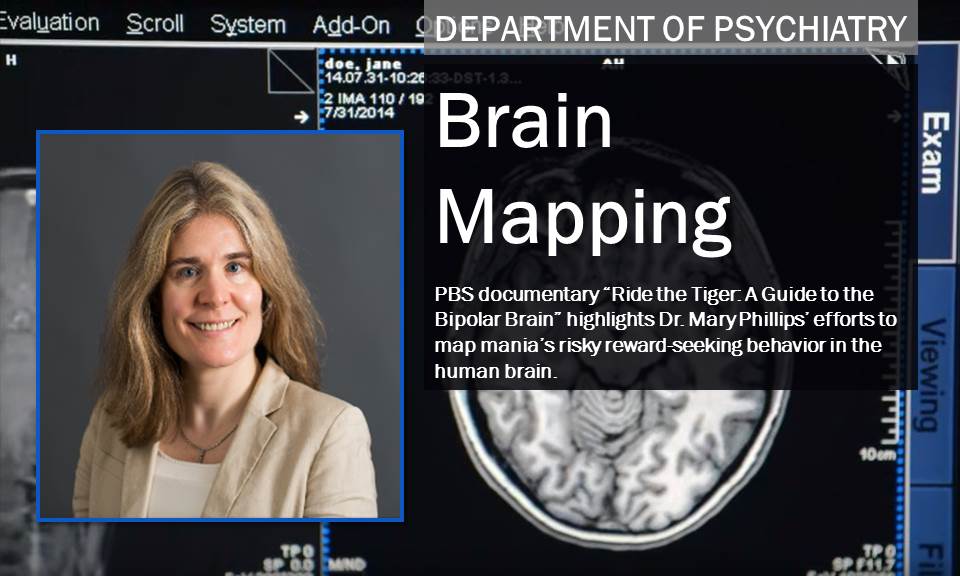
Nearly 6 million Americans have been diagnosed with bipolar disorder and yet little is known about how the illness manifests itself in our brains. A new PBS documentary highlights findings by Dr. Mary Phillips and her team in the Department of Psychiatry Mood and Brain Laboratory.

Ride the Tiger: A Guide through the Bipolar Brain is a one-hour documentary that tells the stories of individuals who have been diagnosed with bipolar disorder.  In the film, Dr. Phillips, Director of the Mood and Brain Laboratory and the Clinical and Translational Affective Neuroscience Program, talks about using functional and structural imaging technology to map mania's risky reward-seeking behavior in the human brain.  

"We know that people with bipolar disorder tend to be more risk takers," said Dr. Phillips. "While they are waiting on the outcome of their behavior, people with bipolar disorder have abnormally increased activity in a particular area of the prefrontal cortex."

Through her research, Dr. Phillips seeks to identify biomarkers - or a biological test - to help diagnose bipolar disorder and disorders characterized by risk-taking and emotional dysregulation. Only by identifying such biomarkers can new treatments be developed to help people suffering from these debilitating illnesses.

Dr. Phillips, the Pittsburgh Foundation-Emmerling Endowed Chair in Psychotic Disorders and Professor of Psychiatry and Clinical and Translational Science, is recognized internationally as an expert in the identification of neural correlates that underlie the symptoms of specific abnormalities in emotion processing in people with mood disorders.  She has published over 280 peer-reviewed articles in scientific and medical journals, including a recent article appearing in Molecular Psychiatry that demonstrated that neuroimaging data from teens with behavioral and emotional problems can partly predict how likely the symptoms are to worsen a year later. This study was featured recently by the Brain & Behavior Research Foundation on its web site. 

For more information regarding Dr. Phillips' research and the Mood and Brain Disorders Laboratory, click here.

University of Pittsburgh logo

Stay connected

  • LinkedIn
  • Bluesky
  • Instagram
  • Facebook
  • Threads

Location

Thomas Detre Hall
3811 O'Hara Street
Pittsburgh, PA 15213
  • Contact Us

Related Websites

  • medschool.pitt.edu
  • pitt.edu

Explore

  • Find People
  • Education
  • Research
  • Patient Care
  • Community & Culture
  • About Us
  • News and Events

Information for

  • Faculty & Staff
  • Prospective Trainees
  • Investigators
  • Patients & Families

Intranet Sites

  • Psy Hub for faculty (requires UPMC log-in and UPMC computer or access through MyApps)
  • Postdoc Portal Postdoc Portal for postdoctoral trainees
  • Office of Grants and Contracts (OGC) website accessible on internal network only

Join Our Newsletter

Stay up to date on department and faculty happenings.

University of Pittsburgh Department of Psychiatry mailing list Fill in the form to subscribe to the mailing list.

Psychiatry Advances Podcast

Covering Innovative research and patient-centered programs.

Listen to Podcast

© 2026 University of Pittsburgh Department of Psychiatry