University of Pittsburgh logo
Department of Psychiatry
University of Pittsburgh logo
Information for You
  • Faculty & Staff
  • Prospective Trainees
  • Investigators
  • Patients & Families
Our People
Menu
  • Education
    • Education Overview
    • Residency & Fellowships
    • Research Training
    • Medical Student Education
    • Clinical Psychology Internship
    • Clinician Career Development
  • Research
    • Research Overview
    • Research Faculty
    • Research Training
    • Investigator Resources
    • Health Equity Research
    • Participate in Research
  • Patient Care
    • Patient Care Overview
    • Access to Care
    • Clinical Services Overview
    • Clinical Faculty
    • Resources for Clinicians
  • Community & Culture
    • Community & Culture Overview
    • Leadership & Advisory Council
    • Research Equity & Community Health
    • Community & Partnership
    • Community News
    • Community Awards & Accolades
  • About Us
    • About Us Overview
    • Chair's Message
    • Our People
    • Our History, Our Present, & Our Future
    • Life in Pittsburgh
  • News & Events
    • News & Events Overview
    • News
    • Events
  • Information for You
    • Faculty & Staff
    • Prospective Trainees
    • Investigators
    • Patients & Families
  • Our People

Main menu

  • Education
    • Residency & Fellowships
      • Residency Training
      • Training Pathways & Concentrations
      • Clinical Fellowships
      • Our Clinical Learning Environment
      • Our Leadership
      • Our Chief Residents
      • Our Residents
    • Research Training
      • Undergraduate & Graduate Student Training
      • Medical Student Research
      • Research During Residency
      • Postdoctoral Training
      • Medical Student Education
      • Clinical Psychology Internship
      • Clinician Career Development
  • Research
    • Research Training
      • Undergraduate & Graduate
      • Medical Student Research
      • Research During Residency
      • Postdoctoral Training
    • Investigator Resources
      • Research Day
      • Research Review Committee
      • Assessment Instruments
    • Health Equity Research
      • REACH Collaborative
      • Research Faculty
      • Participate in Research
  • Patient Care
      • Access to Care
      • Clinical Services Overview
      • Clinical Faculty
      • Resources for Clinicians
  • Community & Culture
      • Leadership & Advisory Council
      • Research Equity & Community Health
      • Community & Partnership
      • Community News
      • Community Awards & Accolades
  • About Us
    • Our People
      • Faculty
      • Staff
      • Emeritus Faculty
      • Chair's Message
      • Our History, Our Present, & Our Future
      • Life in Pittsburgh
  • News & Events
      • News
      • Events
  • Search

Breadcrumb menu

  1. Home
  2. News
  • September 27, 2016
  • Share on LinkedIn
  • Share on Bluesky
  • Share on Facebook
  • Share on Threads
  • Share via email

Hot Publication - JAMA Psychiatry
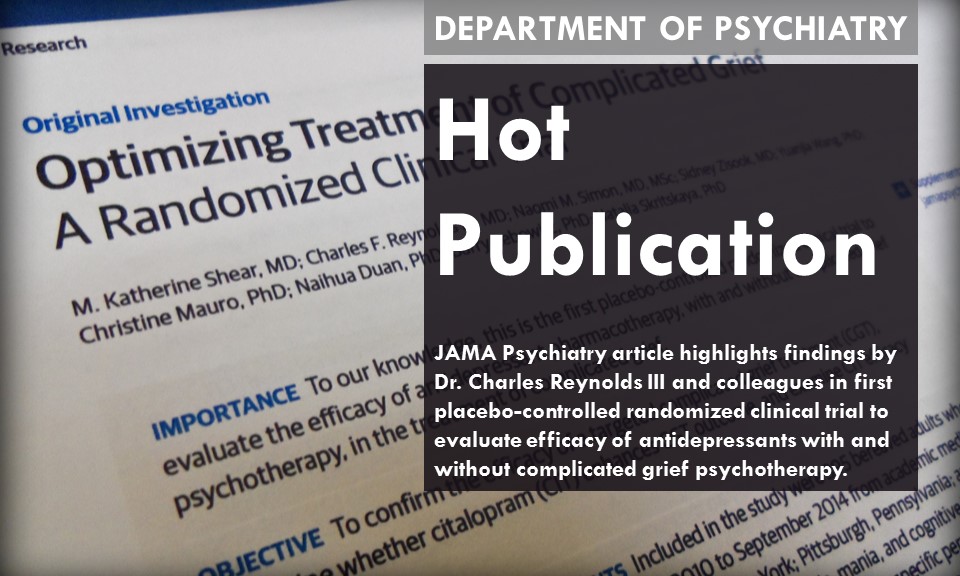


Optimizing Treatment of Complicated Grief: A Randomized Clinical Trial

Shear MK, Reynolds CF, Simon NM, Zisook S, Wang Y, Mauro C, Duan N, Lebowitz B and Skritskaya N
JAMA Psychiatry, 73:685-694, 2016

Dr. Charles F. Reynolds, III, and his colleagues have published the results of the first placebo-controlled randomized clinical trial to evaluate the efficacy of antidepressant pharmacotherapy, with and without complicated grief psychotherapy, in the treatment of complicated grief.  Dr. Reynolds collaborated on the multisite study with investigators from the University of Pittsburgh, Columbia University, Harvard, and the University of California at San Diego.  Their goal was to confirm the efficacy of a targeted complicated grief treatment (CGT), determine whether citalopram (CIT) enhances CGT outcome, and examine CIT efficacy without CGT.

Participants in the study consisted of 395 bereaved adults who met criteria for CG recruited from academic medical centers in Boston, New York, Pittsburgh, and San Diego. They were randomized using site-specific permuted blocks stratified by major depression into groups prescribed CIT (n = 101), placebo (PLA; n = 99), CGT with CIT (n = 99), and CGT with PLA (n = 96). Independent evaluators conducted monthly assessments for 20 weeks. The investigators compared response rates under the intention-to-treat principle, including all randomized participants in a logistic regression with inverse probability weighting.  All participants received protocolized pharmacotherapy optimized by flexible dosing, psychoeducation, grief monitoring, and encouragement to engage in activities. Half of the participants were also randomized to receive manualized CGT in 16 concurrent weekly sessions.  Complicated grief–anchored Clinical Global Impression scale measurements every 4 weeks. 

Dr. Reynolds and his colleagues found that participants’ response to CGT with PLA vs PLA (82.5% vs 54.8%) suggested the efficacy of CGT, and the addition of CIT did not significantly improve CGT outcome. However, depressive symptoms decreased significantly more when CIT was added to treatment. By contrast, adding CGT improved CIT outcome. Additionally, participant response to CIT was not significantly different from PLA at week 12 or at week 20. Rates of suicidal ideation diminished to a substantially greater extent among participants receiving CGT than among those who did not.

Findings from this study confirmed that CGT is the treatment of choice for complicated grief, and the addition of CIT optimizes the treatment of co-occurring depressive symptoms.  

Contributors:
Charles F. Reynolds III, MD (Department of Psychiatry, University of Pittsburgh School of Medicine)

M. Katherine Shear, MD and Natalia Skritskaya, PhD (School of Social Work, Columbia University College of Physicians and Surgeons)

Naomi M. Simon, MD, MSc (Center for Anxiety and Traumatic Stress Disorders, Massachusetts General Hospital, Harvard Medical School)

Sidney Zisook, MD and Barry Lebowitz, PhD (Department of Psychiatry, University of California, San Diego)

Yuanjia Wang, PhD and Christine Mauro, PhD (Department of Biostatistics, Mailman School of Public Health, Columbia University)

Naihua Duan, PhD (Division of Biostatistics, Department of Psychiatry, Columbia University College of Physicians and Surgeons)

This article has been published online in the journal JAMA Psychiatry.  To view the abstract, click here.

University of Pittsburgh logo

Stay connected

  • LinkedIn
  • Bluesky
  • Instagram
  • Facebook
  • Threads

Location

Thomas Detre Hall
3811 O'Hara Street
Pittsburgh, PA 15213
  • Contact Us

Related Websites

  • medschool.pitt.edu
  • pitt.edu

Explore

  • Find People
  • Education
  • Research
  • Patient Care
  • Community & Culture
  • About Us
  • News and Events

Information for

  • Faculty & Staff
  • Prospective Trainees
  • Investigators
  • Patients & Families

Intranet Sites

  • Psy Hub for faculty (requires UPMC log-in and UPMC computer or access through MyApps)
  • Postdoc Portal Postdoc Portal for postdoctoral trainees
  • Office of Grants and Contracts (OGC) website accessible on internal network only

Join Our Newsletter

Stay up to date on department and faculty happenings.

University of Pittsburgh Department of Psychiatry mailing list Fill in the form to subscribe to the mailing list.

Psychiatry Advances Podcast

Covering Innovative research and patient-centered programs.

Listen to Podcast

© 2026 University of Pittsburgh Department of Psychiatry