University of Pittsburgh logo
Department of Psychiatry
University of Pittsburgh logo
Information for You
  • Faculty & Staff
  • Prospective Trainees
  • Investigators
  • Patients & Families
Our People
Menu
  • Education
    • Education Overview
    • Residency & Fellowships
    • Research Training
    • Medical Student Education
    • Clinical Psychology Internship
    • Clinician Career Development
  • Research
    • Research Overview
    • Research Faculty
    • Research Training
    • Investigator Resources
    • Health Equity Research
    • Participate in Research
  • Patient Care
    • Patient Care Overview
    • Access to Care
    • Clinical Services Overview
    • Clinical Faculty
    • Resources for Clinicians
  • Community & Culture
    • Community & Culture Overview
    • Leadership & Advisory Council
    • Research Equity & Community Health
    • Community & Partnership
    • Community News
    • Community Awards & Accolades
  • About Us
    • About Us Overview
    • Chair's Message
    • Our People
    • Our History, Our Present, & Our Future
    • Life in Pittsburgh
  • News & Events
    • News & Events Overview
    • News
    • Events
  • Information for You
    • Faculty & Staff
    • Prospective Trainees
    • Investigators
    • Patients & Families
  • Our People

Main menu

  • Education
    • Residency & Fellowships
      • Residency Training
      • Training Pathways & Concentrations
      • Clinical Fellowships
      • Our Clinical Learning Environment
      • Our Leadership
      • Our Chief Residents
      • Our Residents
    • Research Training
      • Undergraduate & Graduate Student Training
      • Medical Student Research
      • Research During Residency
      • Postdoctoral Training
      • Medical Student Education
      • Clinical Psychology Internship
      • Clinician Career Development
  • Research
    • Research Training
      • Undergraduate & Graduate
      • Medical Student Research
      • Research During Residency
      • Postdoctoral Training
    • Investigator Resources
      • Research Day
      • Research Review Committee
      • Assessment Instruments
    • Health Equity Research
      • REACH Collaborative
      • Research Faculty
      • Participate in Research
  • Patient Care
      • Access to Care
      • Clinical Services Overview
      • Clinical Faculty
      • Resources for Clinicians
  • Community & Culture
      • Leadership & Advisory Council
      • Research Equity & Community Health
      • Community & Partnership
      • Community News
      • Community Awards & Accolades
  • About Us
    • Our People
      • Faculty
      • Staff
      • Emeritus Faculty
      • Chair's Message
      • Our History, Our Present, & Our Future
      • Life in Pittsburgh
  • News & Events
      • News
      • Events
  • Search

Breadcrumb menu

  1. Home
  2. News
  • January 28, 2014
  • Share on LinkedIn
  • Share on Bluesky
  • Share on Facebook
  • Share on Threads
  • Share via email

Hot Publication - Devlin & Colleagues
Coexpression Networks Implicate Human Midfetal Deep Cortical Projection Neurons in the Pathogenesis of Autism
Willsey AJ, Sanders SJ, Li M, Dong S, Tebbenkamp AT, Muhle RA, Reilly SK, Lin L, Fertuzinhos S, Miller JA, Murtha MT, Bichsel C, Niu W, Cotney J, Ercan-Sencicek AG, Gockley J, Gupta AR, Han W, He X, Hoffman EJ, Klei L, Lei J, Liu W, Liu L, Lu C, Xu X, Zhu Y, Mane SM, Lein ES, Wei L, Noonan JP, Roeder K, Devlin B, Sestan N and State MW.

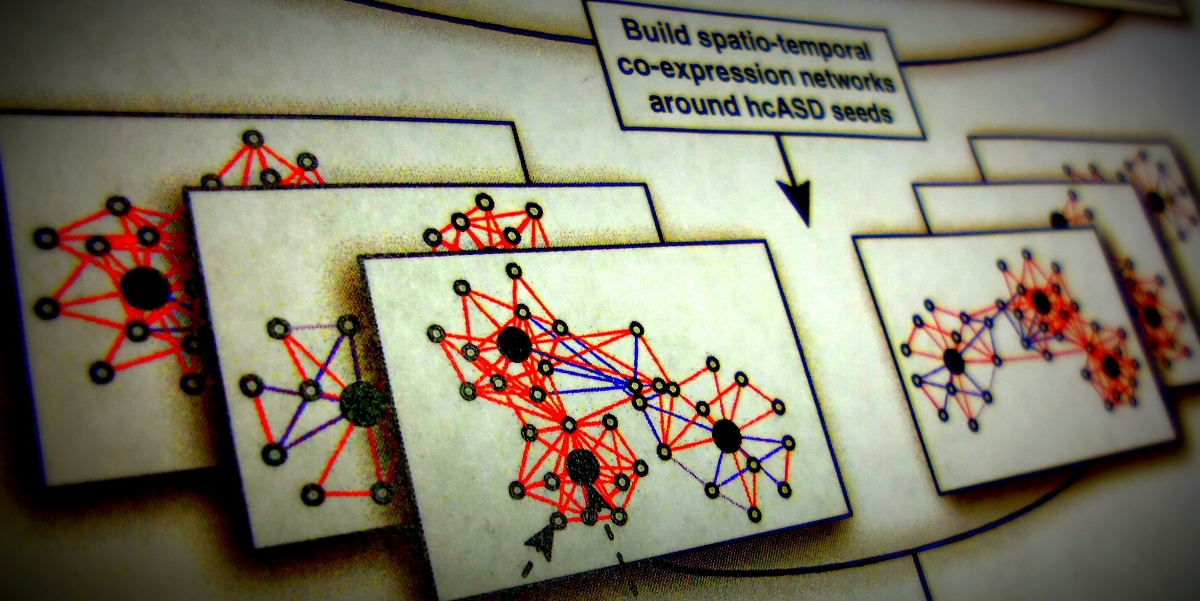
Recent sequencing studies have implicated nine novel genes in risk for autism spectrum disorder (ASD), and garnered modest evidence for over one hundred more; this new work identifies a time period, brain region, and cell type in which the proteins from these genes likely act to convey risk for Autism Spectrum Disorder (ASD).

Autism Spectrum Disorder ? defined by impairments in reciprocal social interaction, often accompanied by other features such as abnormal language development, repetitive behaviors and restricted interests ? onsets prior to age three. The human brain undergoes rapid growth throughout the fetal period and it continues to develop remarkably up to and beyond the age of three. Moreover, by age three the brain is an incredibly complex organ with many distinct regions and cell types.  To understand more about the neurobiology of ASD, the field has been seeking developmental epochs and brain regions in which risk for ASD arises.

For this study, Dr. Bernie Devlin and his collaborators wondered if recent genetic findings, arising from the sequencing of protein-coding regions of the human genome, would yield such clues. These sequencing studies implicated nine genes in risk, which were called ?high confidence? genes, and 122 more with somewhat lower confidence, dubbed ?probable?.   The researchers first asked this question: When these high confidence and probable genes are expressed in the brain, do their proteins co-occur in any particular place and time more than would be expected by chance; i.e., is there unusual co-expression of these genes?  When the team of investigators constructed gene co-expression networks, they found a key point of convergence in the mid-fetal period of the neocortex. Further work garnered evidence that the convergence occurs in particular layers of the developing brain (5/6) and from a particular cell type, cortical projection neurons.

The results of this study inform when, where, and in what cell types mutations in these specific genes likely act to confer risk for ASD.  A caveat, however, is that this nexus of risk is almost certainly not the only one in such a complex organ as the brain and for such a complex disorder as ASD.

Contributors:
Klei Lambertus, PhD and Bernie Devlin, PhD (Department of Psychiatry, University of Pittsburgh School of Medicine)

Xin He, PhD; Jing Lei, PhD; Li Liu, PhD; Cong Lu; and Kathryn Roeder, PhD (Multiple Departments, Carnegie Mellon University)

A. Jeremy Willsey Bsc MPhil; Stephan J. Sanders PhD; Shan Dong, PhD; Rebecca A. Muhle, MD; Steven K. Reilly BS; Wei Niu, PhD; Justin Cotney, PhD; Jake Gockley, BS; Wenzhong Liu; James P. Noonan, PhD; Mingfeng Li, PhD; Andrew T. Tebbenkamp, PhD; Sofia Fertuzinhos, PhD; Candace Bichsel, PhD; Wenqi Han, BS; Xuming Xu, PhD; Ying Zhu, PhD; Nenad Sestan, MD, PhD; A. Gulhan Ercan-Sencicek, PhD; Abha R. Gupta, MD; Ellen J. Hoffman, MD;  Michael T. Murtha; Leon Lin; Shrikant M. Mane, PhD; and Matthew W. State, MD, PhD (Multiple Departments, Yale School of Medicine)

Stephan J. Sanders, MD (Department of Psychiatry, University of California, San Francisco)

Jeremy A. Miller, PhD and Ed S. Lein, PhD (Allen Institute for Brain Science)

Liping Wei, PhD (Center for Bioinformatics, State Key Laboratory of Protein and Plant Gene Research, School of Life Sciences, Peking University and the National Institute of Biological Sciences, Beijing)

The results of this study were published in the journal Cell.  Click here for a link to the abstract.

University of Pittsburgh logo

Stay connected

  • LinkedIn
  • Bluesky
  • Instagram
  • Facebook
  • Threads

Location

Thomas Detre Hall
3811 O'Hara Street
Pittsburgh, PA 15213
  • Contact Us

Related Websites

  • medschool.pitt.edu
  • pitt.edu

Explore

  • Find People
  • Education
  • Research
  • Patient Care
  • Community & Culture
  • About Us
  • News and Events

Information for

  • Faculty & Staff
  • Prospective Trainees
  • Investigators
  • Patients & Families

Intranet Sites

  • Psy Hub for faculty (requires UPMC log-in and UPMC computer or access through MyApps)
  • Postdoc Portal Postdoc Portal for postdoctoral trainees
  • Office of Grants and Contracts (OGC) website accessible on internal network only

Join Our Newsletter

Stay up to date on department and faculty happenings.

University of Pittsburgh Department of Psychiatry mailing list Fill in the form to subscribe to the mailing list.

Psychiatry Advances Podcast

Covering Innovative research and patient-centered programs.

Listen to Podcast

© 2026 University of Pittsburgh Department of Psychiatry